



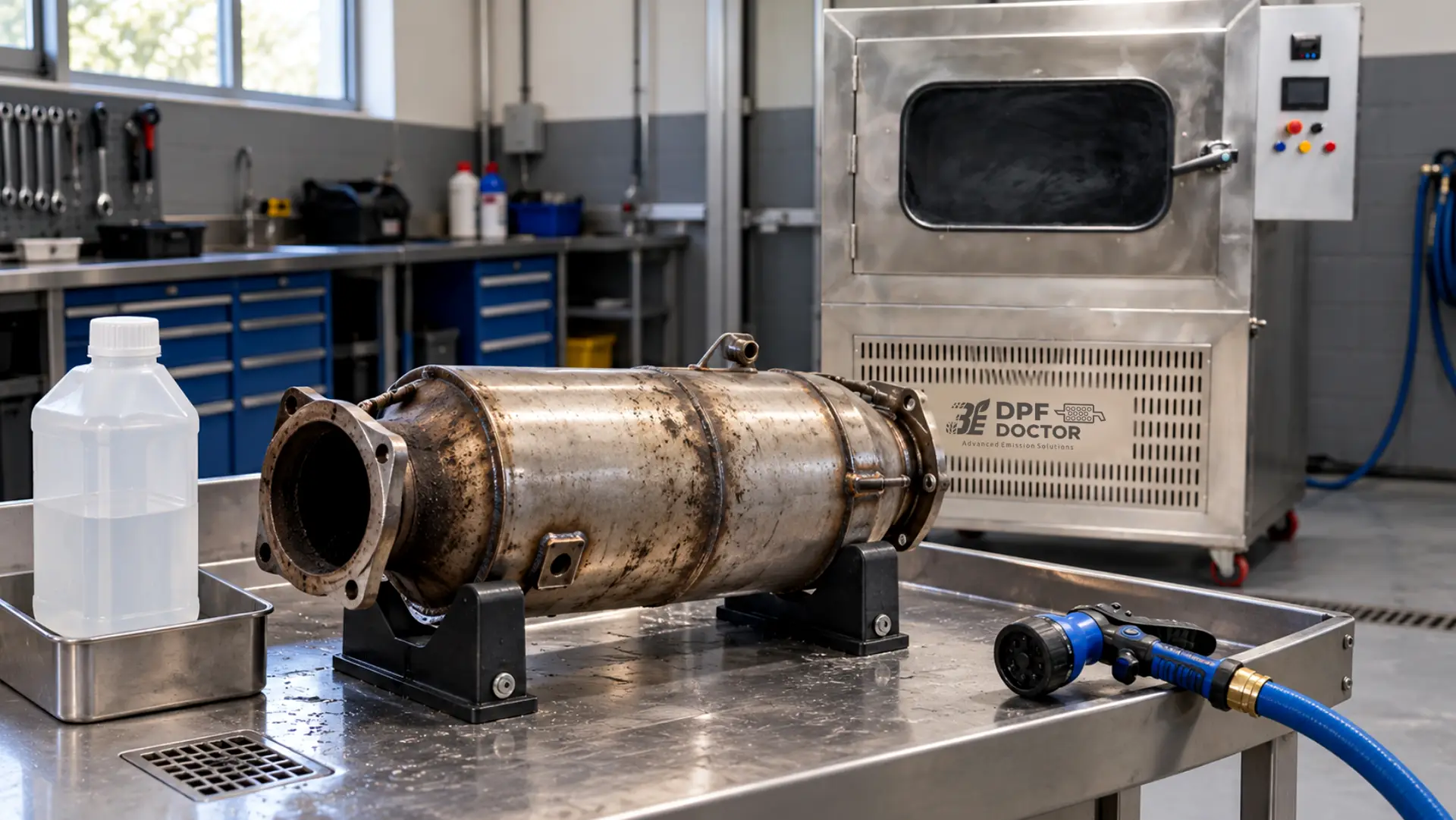
DPF Cleaning Solvent vs. Aqua Flushing: Which Method Restores Airflow Faster?
Blocked DPF does not only negatively affect performance but also costs fuel efficiency, causes false regeneration cycles, and takes vehicles in and out of the workshop until the actual cause has been identified and resolved. All technicians will come to a point of choice at some point in their lives: either flush it with water or get a good DPF cleaning solvent.
It is like a minor choice. It isn't. Choose the wrong one, and the very same car is in your bay in weeks, backpressure creeping up once again, customer confidence leaking out the tailpipe. Select the right one, and you have recreated breath in a fraction of the time and the results are really good.
Let's settle this debate properly — with real mechanics, real numbers, and a few facts that might surprise you.
What's Actually Clogging Your DPF?
You must be aware of what you are fighting before comparing methods. Blocked DPF is not a single issue but rather the combination of two very different villains:
- Soot – soft, carbonous, formed by incomplete combustion, fairly easy to loosen.
- Ash – mineral deposits of engine oil additives, which bake onto the filter walls with time and are difficult to get off except with specific chemistry.
This difference is more than a mere nothingness to the majority. Soot may succumb to pressure and water. Ash rarely does.
How aqua Flushing Actually Works
aqua flushing is literally as it is described, whereby high-pressured water (which is sometimes combined with compressed air) is used to force the water through the filter channels and physically dislodge blockages.
- Performs fairly well on light soot deposits.
- Needs special flushing rigs that have adjustable pressure.
- Leaves ash relatively unchanged, as ash chemically attaches itself to the substrate – not resting freely.
- May require several passes and several hours to filter more than a slightly clogged filter.
- Danger of not fully drying, which will result in an error code in case there is still some moisture left.
Flushing with water is not the worst; it is only restricted. It is a mechanical answer that is requested to answer a chemical question, and that is the point at which the airflow-restoration speed begins to break down.
How a Professional DPF Cleaning Solvent Works
It is here that a professional DPF cleaning solvent comes into play. Rather than using force alone, the right DPF cleaning solution dissolves the stuff that is blocking the filter chemically:
- An efficient DPF soot remover chemical dissolves the carbon deposits at a molecular level.
- One special DPF ash remover chemical specifically attacks the mineral bonds that ash forms with the substrate – that which cannot be touched by water.
- The circulation or soaking of the solvent loosens deposits not only on the surface but also within the pores.
- After being loosened, even a light rinse cleanses out the channels.
- Applicable to all machines, cars, vans, trucks, buses, off-road diesel equipment and more, as the chemistry does not discriminate on what is attached to the filter.
It is not cosmetic; it is mechanical. Solvent only attacks the bond; water only attacks the surface.
The Real Speed Test — Solvent vs aqua Flush
|
Factor |
Aqua Flushing |
Solvent Cleaning |
|
Time for light soot |
30–60 minutes |
20–40 minutes |
|
Time for heavy soot and ash. |
2–4+ hours, often multiple attempts |
45–90 minutes, single cycle |
|
Effectiveness on ash |
Poor |
High |
|
Backpressure reduction |
Partial |
Near-complete |
|
Repeat visits needed |
Common |
Rare |
Trivia
A Bit of History: The EU's Euro 5 standard made diesel particulate filters mandatory on new car models from September 2009, with all new diesel cars required to have them by January 2011 — a rule change that created the entire DPF-cleaning industry workshops now rely on.
Which Solvent Is Used for DPF Cleaning?
It is the question that all workshop owners at some point will pose themselves – and the answer to it is more important than people believe since not all bottles that are marked as cleaner are created in the same way.
An actual DPF diesel particulate filter cleaner ought to be:
- Developed to dissolve not only soot but also ash.
- Not corrosive to ceramic and metallic substrates.
- Catalytic coating safe on the inside of the filter.
- Welcoming at moderate temperatures (no extreme heat necessary that can crack the substrate)
- Interoperable with all types of diesel vehicles: passenger cars, commercial trucks, generators and industrial diesel equipment.
This is precisely the void that products such as 3E DPF Power Clean Solvent are designed to address: a professional DPF cleaning solvent that is designed to fully break down soot and ash in the full spectrum, as opposed to a generic degreaser that is repackaged in DPFs.
Cost, Convenience and Buying Smart
In the case of workshops that operate DPF cleaning as a routine service, the economics is as important as the chemistry:
- DPF cleaning chemical price varies widely — cheap "universal" cleaners often need more product per wash, quietly costing more over time
- A DPF solvent 25-litre container is typically the sweet spot for busy workshops — enough volume to avoid constant reordering, without the storage burden of drums
- Buying DPF cleaning chemicals online saves time versus chasing down local distributors, especially for workshops outside major cities
- For multi-bay garages or fleet maintenance operations, a DPF solvent bulk order brings the per-litre cost down significantly
- Always check the DPF solvent shelf life before stocking up — a good industrial-grade solvent should hold its effectiveness for well over a year in sealed, properly stored containers
- Reliable DPF solvent delivery India coverage matters too — a great product is useless if it takes three weeks to reach your workshop.
Did You Know?
Diesel particulate filters are so effective that they trap roughly 99% of exhaust soot particles under EU Euro 5 standards — but that same efficiency is exactly why a clogged filter builds backpressure fast, forcing the engine to work harder and burn more fuel.
About 3E DPF Doctor
At 3E DPF Doctor, we assist workshops in India to select, install and maximise the use of their DPF cleaning equipment. Whether it comes to choosing the appropriate machine size to match your workload or training your team on best-practice operation, we are all about one thing: reduced breakdowns, improved turnarounds and improved workshop profits. We can help you through the decision-making process, not just sell a machine, whether it is your first DPF cleaning bay or a larger system.
Conclusion
A aqua flush may work just as well and can save you the step, should your DPF be merely moderately dirty. However, to any filter that has to deal with actual soot-and-ash accumulations, that is the majority of what passes through a workshop door, a professional DPF cleaning solvent will have the air moving again quicker, more thoroughly and with a lot fewer reappearances.
Water moves debris. Solvent dissolves it. And when a customer is waiting to pick his vehicle, that difference counts it all.
Ready to Clean the Clean Filters?
Stop relying on aqua flushes that only solve half the problem. Explore the 3E DPF Power Clean Solvent range — available in convenient 25-litre packs, with bulk order pricing for fleet workshops and fast delivery across India.